



 |  |  |  |  |  |  |  |
Improving accessibility for deaf people in multimodal transport systems.
The UNITY Project is an international collaborative initiative involving researchers from Technische Hochschule Ingolstadt (THI) in Germany and the Center for Science for Development – Assistive Technology and Accessibility in Brazilian Sign Language (CCD-TAAL), based at the University of Campinas (UNICAMP), Brazil.
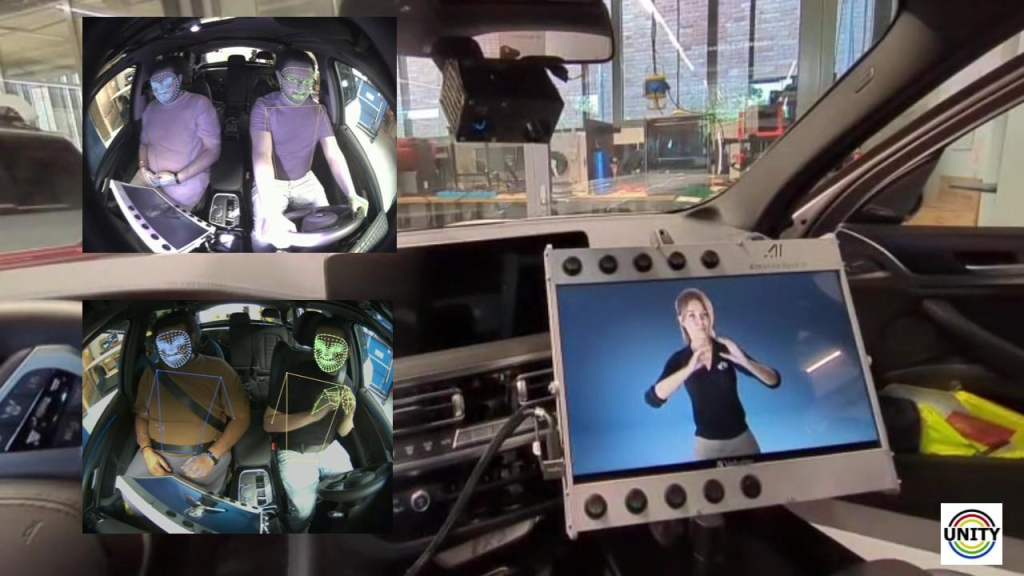
The project investigates and develops technologies for the recognition of Brazilian Sign Language (Libras) and German Sign Language (DGS) in passenger transportation environments, including cars, taxis, ride-hailing vehicles, trams, trains, ships, and aircraft.
Beyond sign language recognition, UNITY explores new User Experience (UX) concepts for in-vehicle multimedia systems and devices such as displays, smartphones, and tablets. The proposed solutions take into account the behavior and needs of vehicle occupants and explore different modes of interaction by combining audio, text, and signing 3D avatars. The goal is to provide passengers and drivers with a more accessible, safe, and comfortable travel experience.
To support these solutions, the project combines multimodal sensing—including conventional cameras, depth cameras, and microphones—with advanced artificial intelligence and deep neural network techniques. This technological framework enables the development, testing, and evaluation of functional proofs of concept under representative real-world conditions, contributing to new forms of accessible interaction in mobility and transportation environments.

The UNITY Project is funded by the São Paulo Research Foundation (FAPESP) under grant no. 2024/23068-4.
*Libras translation in progress. Publication coming soon.*